
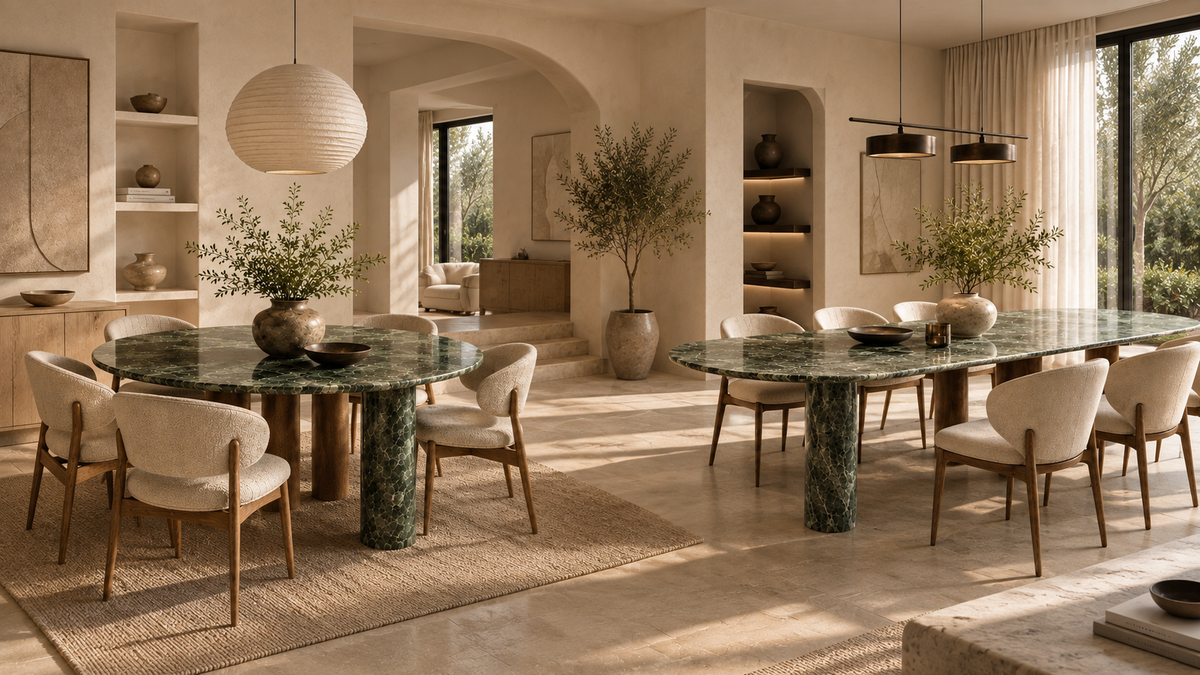
Choosing between a round or rectangular dining table might initially seem like a question of personal taste. In reality, the shape of your table affects everything from how comfortably people can sit together to how easily you can move around the room.
Room proportions, the number of people you regularly seat and the amount of space available around the table are all worth considering before settling on a design.
And size matters just as much as shape. A beautiful table that technically fits into a room can still feel too large once chairs are pulled out and people start moving around it.
So, should you choose a round or rectangular dining table? Here is what to consider.
Round vs rectangular dining tables: what’s the difference?
Neither shape is inherently better. The best dining table shape depends largely on the room it is going into and how you plan to use it.
Round dining tables tend to work particularly well in square rooms and smaller dining areas. Their lack of corners can make movement around the table feel more natural, while everyone sitting around the table faces towards one another.
Rectangular tables make efficient use of longer rooms and tend to become more practical as the number of diners increases. They also offer a larger uninterrupted surface, which can give materials such as natural marble more visual presence.
The dimensions of your room are therefore a better starting point than choosing a shape based on appearance alone.
What are the advantages of a round dining table?
One of the main attractions of a round dining table is how naturally it brings people together. With no obvious head of the table and everyone facing towards the centre, conversation tends to feel more inclusive.
Round tables can also be easier to move around. Removing the corners creates a softer circulation path, which can be particularly useful where space is relatively tight.
Visually, they can soften rooms dominated by straight architectural lines. In marble, this effect can be especially striking. A circular slab of stone draws attention to the natural pattern and veining while creating an almost sculptural centrepiece.
There is, however, a point at which a round table becomes less space-efficient.
A round dining table for four can be extremely compact. A round dining table for six is still practical in many rooms. By the time you need to seat eight people comfortably, however, the diameter becomes substantial.
This is why it is worth considering both the number of diners and the dimensions of the room rather than assuming a round table will always save space.
What are the advantages of a rectangular dining table?
Rectangular dining tables are particularly well suited to longer rooms because their proportions naturally follow the shape of the space.
They also scale particularly well.
A rectangular dining table for six can provide plenty of room without requiring excessive width, while a rectangular dining table for eight generally uses the available floor area more efficiently than a very large circular table.
There is also greater flexibility in how people are seated. Diners can sit along each side, with additional seats at either end when required.
From a design perspective, a long rectangular table can give a room a strong architectural focal point. With a natural marble dining table, the larger surface also gives the stone’s veining and variation room to become part of the design itself.
What size dining table do I need?
There is no single correct dining table size for a given number of people. Chair width, the position of the legs or base, place settings and how generously you like to seat guests all make a difference.
As a practical starting point, allow roughly 60cm of table edge per person for comfortable everyday dining. More space can be preferable with particularly wide dining chairs or chairs with arms.
The following dining table size guide provides useful approximate dimensions:
|
Number of people |
Suggested rectangular table size |
Suggested round table diameter |
|
4 people |
120–140 × 80–90cm |
100–120cm |
|
6 people |
160–180 × 90–100cm |
130–150cm |
|
8 people |
200–240 × 90–110cm |
150–180cm |
These dimensions are a guide rather than a rule. Always look at the specific table design and chair dimensions before deciding how many people a table can comfortably accommodate.
For a more detailed look at measurements, see our guide to choosing the right dining table size.
What size dining table seats 4 people?
For four people, a rectangular table around 120–140cm long will usually provide comfortable everyday seating. A width of around 80–90cm leaves useful space in the centre for serving dishes without making the table unnecessarily large.
For a round dining table for four, a diameter of approximately 100–120cm works well in many homes.
If the table will occasionally accommodate more than four people, choosing towards the larger end of either range gives you a little more flexibility.
What size dining table seats 6 people?
If you’re wondering how long a dining table should be for six people, around 160–180cm is a useful starting point for a rectangular design.
This generally provides enough room for two people at each side and one at each end without the table feeling cramped.
For a round dining table for six, look at approximately 130–150cm in diameter. The exact capacity will depend heavily on the base and chairs. A central pedestal, for example, can make seating easier because there are no table legs competing for space underneath.
What size dining table seats 8 people?
For eight people, a rectangular dining table will typically need to be around 200–240cm long.
Around 200cm may work with relatively compact chairs and closer seating, while 220–240cm gives each person more room. If eight people will use the table regularly rather than occasionally, the additional length is usually worth considering.
So, how long should a dining table be to seat eight comfortably? As a general guide, around 220cm or more provides a more generous everyday arrangement, subject to the particular table and chairs.
A round dining table for eight generally requires a diameter of approximately 150–180cm.
This illustrates an important difference between the two shapes. At larger seating capacities, circular tables become very wide as well as long, while rectangular designs can gain seating capacity primarily by increasing their length.
Do round dining tables save space?
Sometimes, but not always.
For four people in a relatively small or square dining area, a round table can make excellent use of the available space. The absence of corners also makes circulation around it feel less restricted.
For larger groups, the situation changes. Increasing the seating capacity of a round table means increasing its diameter in every direction.
A large round table for eight can therefore occupy more of a room than you might expect. A rectangular table of equivalent capacity may fit more naturally into a long room because most of its additional size is concentrated along one axis.
The better question isn’t simply whether round tables save space, but which shape works with the proportions of your particular room.
How much space do you need around a dining table?
Measuring the tabletop is only half the job.
You also need enough room to pull chairs out, sit comfortably and move behind them.
As a general guide, consider allowing:
- Around 75cm as a workable minimum between the table edge and a wall or other furniture
- Around 90cm for more comfortable everyday use
- Around 100–120cm where people will regularly need to walk behind occupied chairs
These distances are measured from the edge of the tabletop, not from its centre.
For example, imagine you are considering a rectangular table measuring 200 × 100cm.
Adding 90cm of clearance on each side means the dining zone would ideally measure approximately:
380cm × 280cm
That doesn’t necessarily mean the room itself must have exactly those dimensions. Open-plan spaces, door positions and furniture placement all affect how the area works. It does, however, give you a much more realistic idea of the space a table will occupy once it is actually being used.
Is a round or rectangular table better for a small room?
In a small dining room, a round table is often worth considering, particularly if the room itself is close to square.
Without corners, there is less furniture projecting into circulation routes. A pedestal base can make the arrangement even more flexible by allowing chairs to be positioned freely around the perimeter.
That doesn’t automatically make round the best dining table shape for every small room, though.
If the space is small but distinctly rectangular, a compact rectangular table may make better use of its proportions.
What works best in a square dining room?
Square rooms naturally lend themselves to round tables.
Placing a circular table centrally can create balanced space around all sides while providing a clear focal point in the middle of the room.
A square or relatively compact rectangular table can work too, but if you are deciding between round vs rectangular dining tables specifically, a round design often follows the proportions of a square room particularly naturally.
What dining table shape is best for a narrow room?
A rectangular table will usually make more efficient use of a long, narrow dining room.
Rather than extending equally in every direction, the table follows the length of the room while keeping its width relatively restrained.
Pay particular attention to clearance at the sides. A table might fit comfortably lengthways but still leave too little space to pull chairs out.
This is one situation where measuring the complete dining area, including chairs and circulation space, is particularly important.
What about an open-plan kitchen and dining space?
Open-plan spaces give you greater flexibility, so the decision often comes down to how you want to define the dining area.
A rectangular table can visually establish a dining zone within a larger room, particularly when aligned with a kitchen island or the main architectural lines of the space.
A round table creates a different effect. Its contrasting geometry can separate the dining area from a kitchen without needing physical divisions and can help soften a room containing lots of cabinetry, islands and straight lines.
Think about the routes through the space too. If people regularly walk between the kitchen and living area, a table with curved edges may make that movement feel more fluid.
And for a larger dining room?
In a generous dining room, both shapes can work beautifully.
Long rectangular tables have a sense of scale that suits larger spaces and make it relatively straightforward to accommodate eight or more diners.
A substantial round table creates a different kind of focal point. Rather than emphasising the length of the room, it draws attention towards its centre.
At this scale, the decision becomes less about fitting the table into the room and more about how you want the room to feel and function.
Round or rectangular marble dining table?
Shape takes on another dimension when the tabletop is made from natural stone.
A round marble dining table concentrates attention on a single piece of stone. The circular outline can emphasise sweeping veins and contrasting areas of colour, particularly in more expressive marbles.
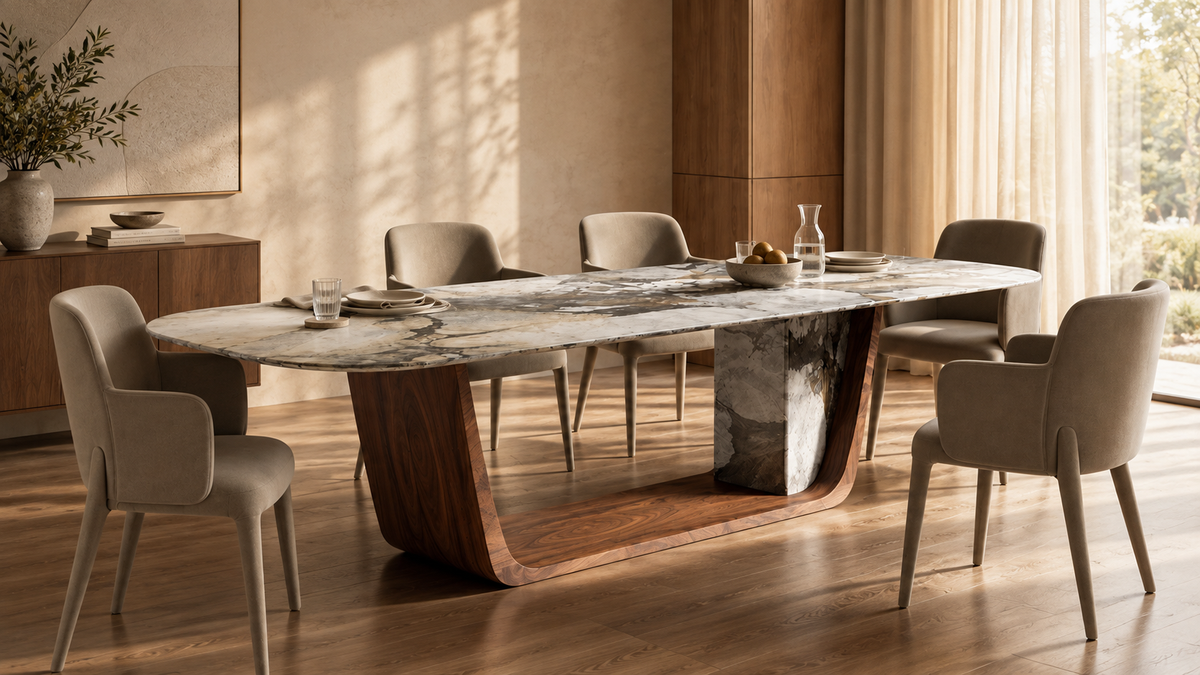
A rectangular marble dining table provides a longer canvas. Linear veining can travel across the surface, while larger slabs allow more of the natural variation within the stone to be seen at once.
There is also the visual weight of the material to consider. Marble has a naturally substantial presence. Pairing it with timber can introduce warmth and contrast, which is one reason a marble and wood dining table can work well in both contemporary and more traditional interiors.
Most importantly, natural marble isn’t uniform. Colour, veining and pattern vary from one piece of stone to another. These differences aren’t imperfections. They’re part of what distinguishes natural marble from manufactured surfaces.
If you’re considering marble furniture, our guides to What is Marble? and How to care for a marble dining table explore the material in more detail.
You can also explore our marble dining tables to compare different proportions, stone finishes and table shapes.
Don’t forget the table base
The dimensions of a tabletop don’t tell you everything about how many people can comfortably sit around it.
A four-leg rectangular table may lose some usable seating space near the corners, particularly if the legs are inset from the ends.
Pedestal and sculptural central bases can provide greater flexibility because chairs aren’t competing with individual legs for space. This can be especially useful with round tables.
Always look underneath the table when judging seating capacity, not just at the measurements on the product page.
Consider the chairs too
Dining chairs vary considerably in width.
Slim, armless chairs allow people to sit closer together, while wide upholstered chairs and dining armchairs require more space. This explains why two tables with identical dimensions may realistically accommodate different numbers of people.
It’s also worth distinguishing between everyday capacity and occasional capacity.
A table that comfortably seats six every evening might accommodate eight for an occasional dinner. That doesn’t necessarily mean eight people would want to sit around it every day.
If you regularly entertain, choosing a little more space than the minimum can make a noticeable difference.
Think about access before ordering a marble table
Finally, with substantial natural stone furniture, consider how the table will physically reach the room.
Measure doorways, hallways, staircases and any particularly tight turns between the entrance to your home and the final position of the table.
Natural marble is heavy, and larger tabletops can be difficult to manoeuvre even when the room itself has plenty of space.
It’s a simple measurement that’s much better made before delivery day.
So, should you choose a round or rectangular dining table?
There isn’t a universal answer, but your room will usually provide some useful clues.
Choose a round dining table if:
- Your dining area is square or relatively compact
- You want conversation to feel centred and inclusive
- You prefer softer lines within the room
- Circulation around corners is limited
- You typically seat four to six people
- You want a marble tabletop to create a central sculptural feature
Choose a rectangular dining table if:
- Your room is long or narrow
- You regularly seat six, eight or more people
- You want to maximise seating without dramatically increasing table width
- You prefer a stronger, more architectural shape
- You want a larger uninterrupted surface to showcase natural marble
- Your dining table needs to accommodate larger gatherings
Whichever shape you prefer, start with the room rather than the table. Measure the available space, allow for chairs and circulation, and think about how many people will actually use the table day to day.
Once those practical questions are answered, choosing between round and rectangular becomes much simpler.


Leave a comment
This site is protected by hCaptcha and the hCaptcha Privacy Policy and Terms of Service apply.