
Choosing the right dining table size is about more than deciding how many people you want to seat. A table needs to fit comfortably within the room, provide enough space for each person and leave sufficient clearance for chairs and people to move around it.
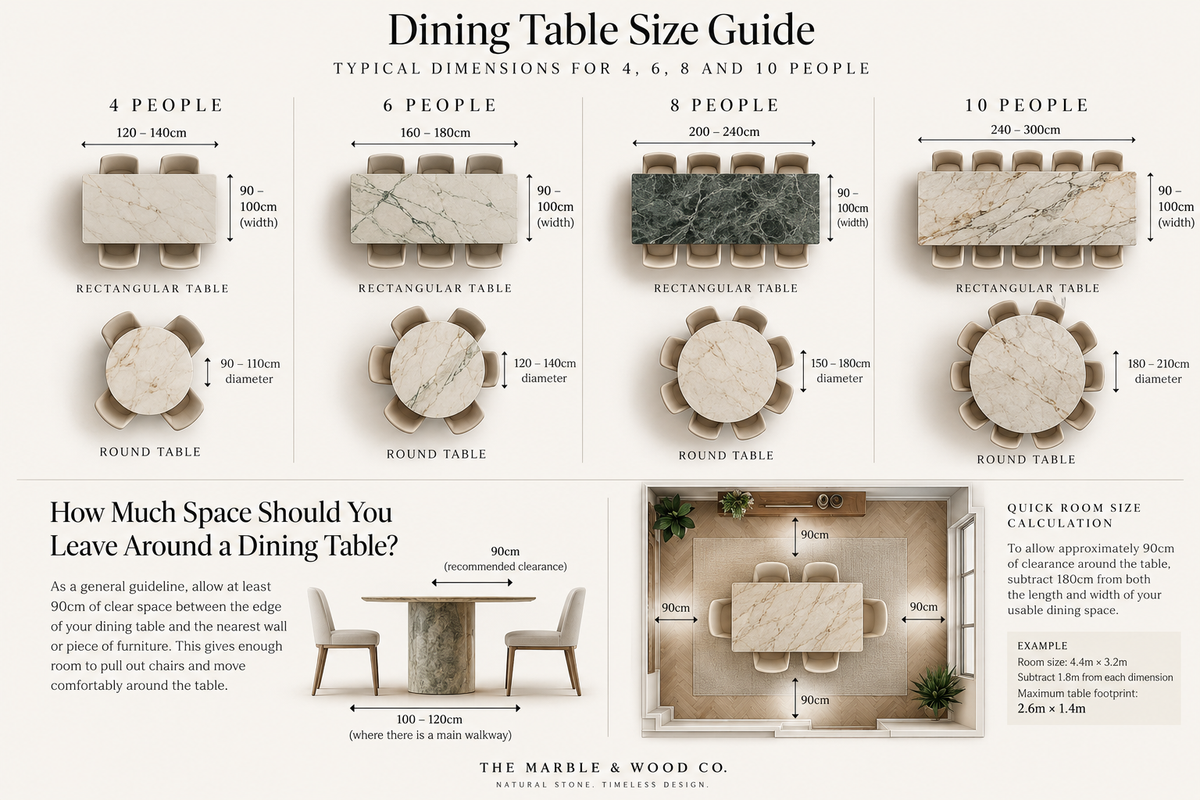
As a general rule, allow around 60cm of table width per person and aim for approximately 90cm of clear space around the dining table where possible.
This dining table size guide covers typical dimensions for 4, 6, 8 and 10 people, as well as dining table height, room clearance and how to work out what size table will fit your space.
Dining Table Size Chart
The ideal dimensions depend on the shape and design of the table, but the following measurements provide a useful starting point.
|
Number of people |
Rectangular table length |
Typical round table diameter |
|
4 people |
120–140cm |
90–110cm |
|
6 people |
160–180cm |
120–140cm |
|
8 people |
200–240cm |
150–180cm |
|
10 people |
240–300cm |
180–210cm |
These measurements are guidelines rather than strict rules. The position and shape of the table base or legs, the width of your dining chairs and how formally you intend to set the table can all affect how many people can sit comfortably.
A pedestal or central base, for example, can sometimes provide greater flexibility than four legs positioned close to the corners.
How Much Space Does Each Person Need at a Dining Table?
A useful starting point is to allow approximately 60cm of table edge per person.
For more generous dining, particularly when using larger upholstered dining chairs, allowing 65–75cm per person can feel considerably more comfortable.
Depth matters too. Each diner needs enough room for a place setting, while the centre of the table needs space for serving dishes, glasses or decorative pieces.
For this reason, a dining table should generally be around 90cm wide or more if you want comfortable place settings on both sides with usable space through the centre.
What Size Dining Table for 4 People?
For four people, a rectangular dining table of approximately 120–140cm long is usually sufficient.
A round table measuring around 90–110cm in diameter can also work well for four people and is particularly useful in smaller or more square-shaped dining spaces.
If you regularly entertain, choosing a slightly larger table can give you greater flexibility without making everyday dining feel oversized.
What Size Dining Table for 6 People?
For six people, look for a rectangular dining table approximately 160–180cm long.
At 180cm, three people can usually sit along each side when required, although many arrangements use two chairs on each side and one at either end.
For a round dining table, approximately 120–140cm in diameter is a useful starting point for six people.
When comparing tables, don’t consider the tabletop dimensions alone. A wide table base or unusually positioned legs can reduce usable seating space, so look at the complete design.
What Size Dining Table for 8 People?
An eight-seater rectangular dining table will typically measure around 200–240cm long.
At this size, the table becomes a substantial feature within the room, so the space surrounding it becomes just as important as the tabletop dimensions.
A round table for eight people generally requires approximately 150–180cm in diameter. Large round tables can create a striking focal point, although their overall footprint can become considerable once chairs and circulation space are included.
What Size Dining Table for 10 People?
For ten people, a rectangular table will commonly need to be around 240–300cm long, depending on chair width and seating arrangement.
A 260cm table, for example, provides significantly more dining space than a typical six-seater and can work particularly well in larger dining rooms and open-plan spaces.
For a round table seating ten, approximately 180–210cm in diameter may be required.
At these dimensions, measuring the room carefully is essential. Large dining tables can look perfectly proportioned in isolation but feel very different once chairs, sideboards and other furniture are added.
How Much Space Should You Leave Around a Dining Table?
As a general guideline, aim for approximately 90cm between the edge of your dining table and the nearest wall or large piece of furniture.
This allows space to pull out a chair and move behind it.
Where the main walkway through the room passes behind the chairs, 100–120cm or more can feel considerably more comfortable.
In a tighter room, around 75cm may be workable in some areas, but movement will be more restricted once someone is seated.
Remember to measure from the edge of the tabletop, not from the table base.
A Simple Way to Calculate Your Maximum Dining Table Size
If you want approximately 90cm of clearance around the table, subtract 180cm from both the length and width of the available room space.
For example, if the usable dining area measures:
4.4m × 3.2m
subtract 1.8m from each dimension:
Maximum approximate table footprint: 2.6m × 1.4m
This doesn’t necessarily mean you should buy a table that fills the entire 260 × 140cm footprint. Other furniture, doorways and important walking routes also need to be considered.
However, it provides a useful starting point when deciding whether a particular table size is realistic for your room.
What Is the Standard Height of a Dining Table?
Most standard dining tables are approximately 74–76cm high.
This height is designed to work comfortably with conventional dining chairs, although individual table designs can vary.
When choosing chairs for an existing table, the important measurement is the distance between the seat and the underside of the table rather than simply the overall table height.
This becomes particularly important with tables featuring a substantial apron or thicker natural-stone top.
How Wide Should a Dining Table Be?
For most dining tables, approximately 90–100cm wide provides a good balance between comfortable place settings and usable space in the centre.
Narrower tables can work particularly well in restricted spaces, but there may be less room for serving dishes.
Tables measuring 100cm or more in width can create a more generous dining experience and give decorative centrepieces and serving dishes additional space.
Very wide tables can, however, make conversation across the table less intimate, so bigger isn’t automatically better.
Round or Rectangular: Which Table Shape Uses Space Best?
The shape of the room should influence the shape of the table.
Rectangular dining tables are particularly well suited to longer rooms and generally provide the greatest flexibility when seating larger groups.
Round dining tables work beautifully in square rooms and remove sharp corners, creating a natural flow around the table. They can also make conversation between everyone at the table easier.
As round tables become larger, however, reaching the centre can become more difficult and their total footprint increases considerably.
For a more detailed comparison, read our Round vs Rectangular Dining Tables: Which Is Right for Your Space? guide.
What Size Dining Table Will Fit in My Room?
Before ordering a dining table, measure the usable dining area rather than simply measuring the entire room.
Consider:
- Walls and fixed features
- Doors and the direction in which they open
- Kitchen islands
- Sideboards and cabinets
- Radiators
- Main walking routes
- The depth of your dining chairs when pulled out
A useful technique is to mark the proposed tabletop dimensions on the floor using masking tape.
Then pull your existing chairs up to the outline - or place objects where the chairs would sit - to get a better impression of the table’s real footprint.
This is particularly useful when considering a large statement dining table. A difference of 20 or 30cm can seem insignificant on a product page but can noticeably change how the room feels.
Choosing the Right Size Marble Dining Table
Natural marble dining tables have considerable visual presence, so proportion is especially important.
A large marble table can become the focal point of a dining room or open-plan living space. However, choosing the largest table that will physically fit isn’t always the best approach.
Consider how the table relates to the scale of the room and the furniture surrounding it.
You should also consider the table base. Sculptural bases can be an important part of the design of a luxury dining table, but their position can influence where chairs can comfortably sit.
With substantial natural marble furniture, access is another important consideration. Check door widths, hallways, staircases and any restricted access between the entrance to your home and the final room before ordering.
At The Marble & Wood Co., our dining tables are individually made using natural materials. Each piece of marble has its own veining, tone and character, making every table unique.
Browse our Marble Dining Tables collection to compare the dimensions and designs available.
Dining Table Size FAQs
Is a 180cm dining table big enough for 6 people?
In most cases, yes. A 180cm rectangular dining table will generally accommodate six people comfortably, although the width of the chairs and position of the table base should also be considered.
How many people can sit at a 200cm dining table?
A 200cm rectangular dining table will typically accommodate six people very comfortably and may seat eight depending on the design, chair width and position of the table legs or base.
How many people can sit at a 240cm dining table?
A 240cm rectangular dining table can commonly accommodate eight people, although individual designs and chair sizes vary.
Is 90cm enough space around a dining table?
Approximately 90cm is a useful target because it generally provides room to pull out dining chairs and move around the table. More space may be desirable where there is a busy walkway behind the chairs.
How far should a dining table be from a wall?
Aim for around 90cm where possible. If people regularly need to walk behind occupied chairs, approximately 100–120cm can provide a more comfortable circulation route.
Is a 75cm gap around a dining table enough?
A 75cm gap can work where space is restricted, but it will feel tighter, particularly when someone is sitting at the table. If the room allows, approximately 90cm provides more comfortable everyday use.
Should I buy a 6- or 8-seater dining table?
Think about how you use the table most of the time rather than only on special occasions. If six people will use it regularly and your room has sufficient space, the additional surface area of an eight-seater can make everyday dining feel more generous while providing flexibility when entertaining.
However, a well-proportioned six-seater will usually look better than an oversized eight-seater squeezed into a smaller room.
Finding the Right Dining Table
The right dining table should accommodate the people around it without overwhelming the room.
Start by measuring your available space, allow approximately 90cm of clearance around the table where possible, and then consider how many people you need to seat regularly.
As a quick guide:
4 people: approximately 120–140cm rectangular
6 people: approximately 160–180cm rectangular
8 people: approximately 200–240cm rectangular
10 people: approximately 240–300cm rectangular
Once you’ve established the dimensions that work for your room, you can concentrate on the part that makes the table yours: the material, shape and design.
Explore The Marble & Wood Co. Dining Table Collection to discover made-to-order dining tables crafted from natural marble and wood.

Leave a comment
This site is protected by hCaptcha and the hCaptcha Privacy Policy and Terms of Service apply.