
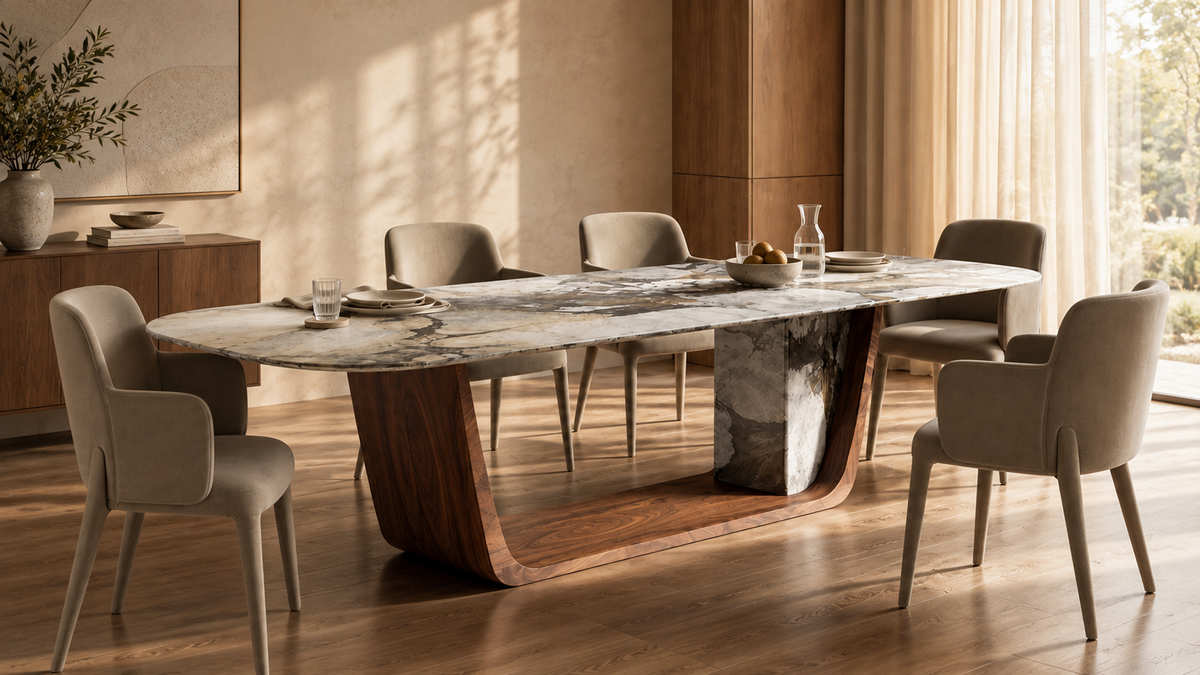
A natural marble dining table is designed to be used, not simply admired. Marble is a substantial natural stone that has been used in buildings, sculpture and interiors for centuries, but that does not mean it is completely maintenance-free.
The good news is that marble table care is relatively straightforward. Most of it comes down to cleaning the surface gently, dealing with spills reasonably quickly and understanding which products are best kept away from the stone.
Natural marble is also exactly that: natural. Its precise characteristics vary according to the stone, its finish and how the furniture has been made. Care instructions supplied with your particular table should therefore take priority over general advice.
How to clean a marble dining table
For everyday cleaning, you usually do not need anything complicated.
A soft microfibre cloth with warm water is suitable for light, routine cleaning. For a more thorough clean, use a cleaner specifically stated to be suitable for natural stone or marble. A pH-neutral product is generally preferable.
Wipe the surface gently rather than scrubbing it, then dry it with a clean, soft cloth. Drying the tabletop helps prevent water marks and residue being left on the surface.
One of the most common mistakes is assuming that a stronger cleaning product will produce a better result. Marble does not benefit from aggressive cleaning. Harsh chemicals and abrasive products can affect the finish of the stone, so a gentler approach is usually the better one.
If you are using a cleaning product for the first time, follow both the furniture manufacturer’s instructions and those supplied with the cleaner.
What should you avoid using on marble?
Some everyday household cleaners are unsuitable for natural marble.
In particular, avoid using acidic cleaners such as vinegar or lemon-based cleaning solutions. Marble is primarily composed of calcium carbonate, which reacts with acids. An acidic substance can therefore alter the surface rather than simply cleaning it.
This is also why a homemade mixture containing vinegar, despite being useful for cleaning many areas of the home, is a poor choice for a marble tabletop.
Strong chemicals such as bleach should not be treated as routine marble cleaners either. Unless a product is specifically confirmed as suitable for the particular natural stone and finish, it is safer to use an appropriate stone cleaner.
Physical abrasion matters too. Scouring pads, abrasive powders and rough cleaning tools can dull or scratch a polished surface.
The simple rule is to avoid experimenting with strong household products. Marble generally responds better to gentle cleaning with products intended for natural stone.
What happens if you spill something on marble?
A dining table will inevitably encounter spills. There is no need to panic every time a drink lands on the surface, but it is sensible to wipe spills up promptly rather than leaving them sitting on the stone.
Natural marble has some porosity, although the degree varies between different stones and finishes. Liquids left on the surface may have an opportunity to penetrate the stone, particularly if the surface is unsealed or the existing sealer is no longer performing effectively.
Wine, coffee, oils, sauces and strongly coloured foods are worth dealing with quickly.
Acidic liquids deserve particular attention. Lemon juice, some fruit juices, vinegar and wine can react with marble and cause etching.
Blotting a spill can be preferable to spreading it over a larger area. Once the spill has been removed, clean the area appropriately and dry it with a soft cloth.
A brief spill does not automatically mean a marble table is ruined. Prompt, sensible cleaning simply reduces the opportunity for staining or surface damage.
Marble staining and etching are not the same thing
Staining and etching are often discussed as though they are interchangeable, but they describe two different problems.
What is a marble stain?
A stain occurs when a substance penetrates the stone and causes discolouration. Oils, drinks and other liquids can potentially cause staining if they are absorbed.
A stain tends to change the colour or tone of the marble in the affected area.
What is marble etching?
Etching is different. It is a physical change to the surface caused by a chemical reaction, most commonly involving an acidic substance.
Rather than simply leaving colour behind, the acid reacts with the calcium carbonate in the marble. On polished marble, an etched area can appear duller or lighter than the surrounding surface and may be particularly noticeable when viewed from an angle.
This distinction matters because cleaning a mark will not necessarily remove an etch. If the surface itself has been altered, repeatedly applying stronger cleaning products is unlikely to solve the problem and could make matters worse.
For significant staining, etching or damage, seek advice appropriate to the particular stone and finish rather than trying increasingly aggressive DIY treatments.
Does a marble dining table need sealing?
This is one of the most common questions about natural marble, and there is not a single schedule that applies to every table.
Many natural stone surfaces are treated with a penetrating or impregnating sealer. These products are designed to reduce the rate at which liquids can penetrate the stone, giving you more opportunity to deal with spills before they become stains.
A sealer should not be confused with an impenetrable coating.
Sealed marble can still stain, particularly if a substance is left on it for long enough. More importantly, a penetrating sealer does not make marble resistant to acid. Wine or lemon juice can still etch a sealed marble surface.
How often a table needs to be resealed depends on several factors, including the marble itself, its finish, the type of sealer originally used and how heavily the table is used.
For that reason, blanket advice such as resealing marble every six months or every year can be misleading. Follow the care information provided with your table and the recommendations for the particular sealing product where known.
If you are unsure whether a surface requires resealing, seek advice before applying another product. Different finishes and treatments can have different requirements.
How to protect a marble dining table
Owning natural marble does not mean hiding it beneath a tablecloth.
A few sensible habits can reduce the chance of damage while still allowing the stone to remain visible.
Coasters are useful for drinks, particularly acidic ones. Placemats can provide some protection during meals, and trivets should be used beneath hot cookware and serving dishes.
Be conscious of items with rough or abrasive bases too. Ceramics, plant pots and decorative objects can sometimes have surprisingly coarse undersides. Felt pads or another suitable protective layer can be useful beneath objects that remain on the table.
These precautions are particularly worthwhile on polished marble, where changes to the surface finish can be more noticeable.
The aim is not to protect the table from every instance of normal use. It is simply to avoid the types of contact most likely to cause unnecessary marks.
Can you put hot dishes on a marble table?
Natural stone itself can tolerate temperatures that would be problematic for many other furniture surfaces, but that does not make placing very hot cookware directly onto a marble dining table a good habit.
A finished piece of furniture is more than a slab of stone. Sealers, adhesives, finishes and other materials may all form part of its construction. Rapid or uneven temperature changes are also best avoided.
Using a trivet beneath hot pans, casserole dishes and serving plates is an easy precaution and removes much of the uncertainty.
It also protects the surface from food, oil and moisture that may be present on the bottom of cookware.
Can marble dining tables scratch?
Marble is a durable natural material, but it is not scratch-proof.
Avoid dragging heavy, sharp or abrasive objects across the tabletop. Lift them instead. Particular care should be taken with decorative objects, crockery or equipment with rough bases.
The edges of a marble tabletop also deserve some consideration. Stone can be extremely substantial while still being vulnerable to chipping if a hard object strikes an exposed edge with sufficient force.
Normal use should not require treating a marble dining table as though it is fragile. A little awareness around heavy or abrasive objects goes a long way.
Natural variation is not damage
One of the attractions of genuine marble is that it is not manufactured to be completely uniform.
Veining, tonal changes, mineral deposits and differences in pattern are created by natural geological processes. As a result, two pieces cut from natural marble will not be identical.
These characteristics should not be confused with staining, etching, scratching or physical damage that occurs during use.
If you are considering buying marble furniture, understanding this distinction before ordering is useful. Our guide to What Is Marble? A Guide to Natural Marble looks more closely at how marble forms and why its appearance varies.
Our A Guide to Choosing Natural Marble Furniture also explains some of the things worth considering when selecting a piece for your home.
Natural materials may acquire signs of use over time, particularly in a busy dining space. Some owners are comfortable with this gradual change, while others prefer to keep a polished surface looking as close as possible to its original condition. Neither approach changes the fact that avoidable damage and poor workmanship are different from the inherent characteristics of natural stone.
Why different marble tables can require different care
It is tempting to think of marble as one standardised material, but the word covers a wide range of natural stones with different characteristics.
The finish matters too. A highly polished marble surface does not necessarily behave or age in exactly the same way as a honed surface.
Then there is the furniture itself. The thickness and amount of stone, construction, supporting materials and surface treatment can all differ between pieces.
This is one reason that generic advice found online should not override the instructions supplied with a particular table.
These differences also help explain why apparently similar pieces of marble furniture can vary considerably in cost. We explore this in more detail in Why Does Marble Furniture Vary So Much in Price?
A simple marble table care routine
You do not need an elaborate maintenance routine to look after a marble dining table. Five habits cover most everyday situations:
- Wipe spills promptly. Pay particular attention to acidic liquids, oils and strongly coloured food or drink.
- Clean gently. Use a soft cloth and a suitable pH-neutral natural stone cleaner where required.
- Avoid acidic and abrasive cleaners. Vinegar, lemon-based cleaning products and abrasive pads should not form part of your normal cleaning routine.
- Use coasters, placemats and trivets where appropriate. They provide simple protection during everyday use without permanently covering the marble.
- Follow the care and sealing guidance supplied with your furniture. Different stones, finishes and treatments can have different requirements.
Caring for natural marble does not need to be complicated
A marble dining table requires a little more thought than a completely non-porous manufactured surface, but the basic care involved is straightforward.
Clean it gently, deal with spills rather than leaving them sitting on the surface, keep acidic cleaners away from it and use simple protection where it makes sense. Just as importantly, learn to recognise the natural characteristics that make marble marble.
At The Marble & Wood Co., natural variation is part of the appeal of furniture made using genuine stone. Understanding the material before buying makes it easier to choose a piece that suits both your home and the way you intend to use it.
If you are still deciding whether natural marble is right for you, start with our Guide to Choosing Natural Marble Furniture, or learn more about the stone itself in What Is Marble? A Guide to Natural Marble.
FAQs
How do you clean a marble dining table?
For routine cleaning, use a soft microfibre cloth with warm water. Where a cleaning product is required, choose one suitable for natural stone, typically a pH-neutral cleaner. Avoid abrasive cleaning tools and dry the surface with a soft cloth afterwards.
Does marble stain easily?
Natural marble has some porosity and can absorb liquids, although this varies between stones, finishes and treatments. Wiping spills promptly and following the appropriate sealing guidance can reduce the risk of staining.
Does a marble dining table need to be sealed?
Many marble surfaces benefit from an appropriate penetrating or impregnating sealer, but there is no universal resealing schedule. Requirements depend on the stone, finish, sealer and use of the table. Sealing can improve stain resistance, but it does not make marble completely stain-proof or protect it from acid etching.
Can you put hot plates directly on a marble table?
Using a trivet is recommended. Although marble itself can tolerate heat, a finished table may also incorporate sealers, adhesives and other materials. A trivet also protects the surface from food, oils and moisture underneath hot cookware.
What is the difference between staining and etching on marble?
A stain is discolouration caused by a substance penetrating the stone. Etching is a physical change to the marble surface, usually caused by contact with an acid. An etched area on polished marble may appear dull or lighter than the surrounding surface.

Leave a comment
This site is protected by hCaptcha and the hCaptcha Privacy Policy and Terms of Service apply.