
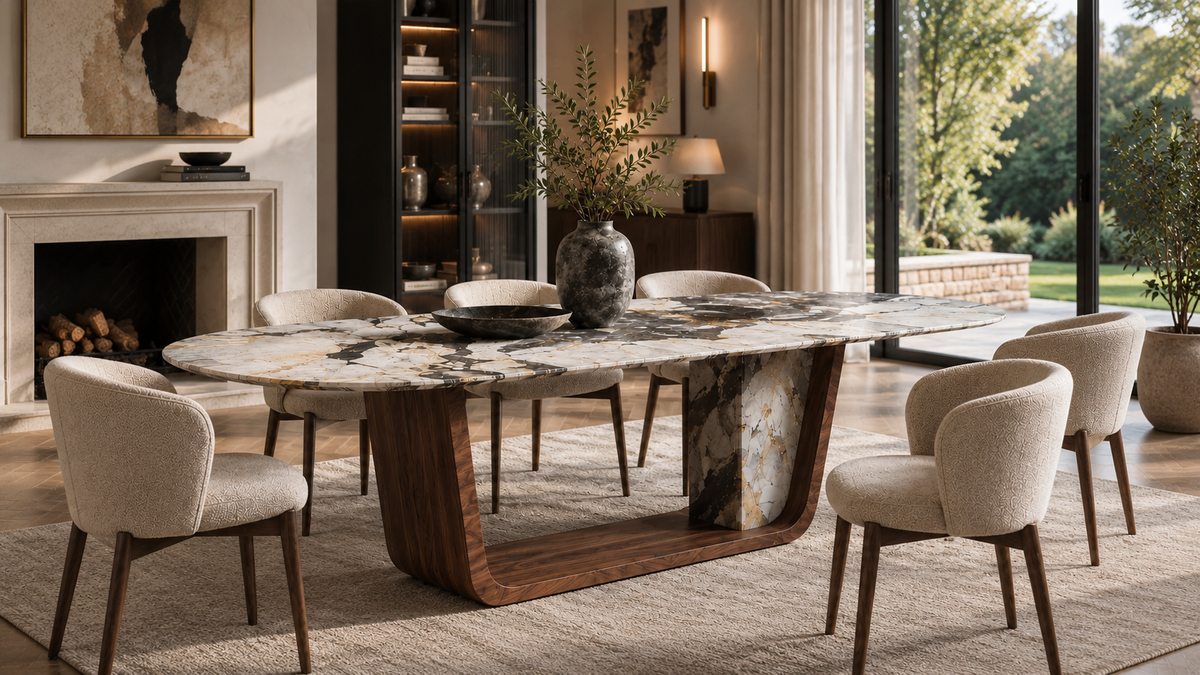
Search for a marble coffee table or dining table online and you will quickly find an enormous range of prices. One table might cost a few hundred pounds, while another seemingly similar design costs several thousand.
At first glance, that can be difficult to understand. They may both be described as marble tables and, particularly in photographs, may not look dramatically different.
The answer is that the word “marble” does not always tell you very much about how a piece of furniture is actually made. Two products appearing in the same search results can use very different materials, quantities of stone and methods of construction.
Understanding those differences makes comparing marble furniture considerably easier.
Is it actually natural marble?
This is the first thing worth checking.
Natural marble is stone quarried from the earth and then cut and processed for use. Geologically, true marble is a metamorphic rock, formed when limestone is subjected to heat and pressure.
However, a marble appearance can be achieved in several other ways.
You may come across furniture made using engineered or composite stone, ceramic or sintered surfaces, printed marble-effect materials, or a thin layer of natural stone applied over another material.
None of these materials is inherently “bad”. In fact, they can make sense where cost, weight, consistency or particular performance characteristics are priorities. But they are not necessarily equivalent to furniture made using substantial pieces of natural marble.
This is why price alone cannot tell you whether marble is genuine. Equally, a low price does not automatically mean that something advertised as marble contains no natural marble at all.
The important thing is to look beyond the photograph and read the specification.
Natural marble and marble effect are fundamentally different
A manufactured marble-effect surface is designed to reproduce the appearance of stone. Depending on the material and manufacturing process, the pattern can be remarkably convincing.
Natural marble is different because the pattern is part of the stone itself.
Its veins, markings and changes in tone developed naturally, which means variation is expected rather than considered a defect. The Natural Stone Institute describes the appearance of marble as naturally random and defines natural stone as material quarried from the earth and processed without altering its natural fabric.
This means that if you order a natural marble table, you should not expect the exact arrangement of veins shown in the product photograph. Your table will have its own variation.
For some buyers, that individuality is precisely the attraction of natural stone. Others may prefer the greater consistency that a manufactured surface can offer.
Why can two real marble tables still have very different prices?
Even once you establish that two pieces both use genuine natural stone, you still aren’t necessarily comparing like for like.
The amount of marble matters
A small marble insert and a substantial stone tabletop can both legitimately feature in furniture described as containing marble.
Look at the dimensions, construction and, where provided, thickness of the stone. A large marble dining table naturally requires considerably more material than a small side table.
Weight can also provide useful context, although it should not be used on its own to determine whether something is genuine.
Not all marble is the same
Marble isn’t a single uniform commodity.
Different stones have different colours, patterns, geological characteristics and availability. Even slabs of the same type of marble can look noticeably different.
It therefore makes little sense to assume that every piece of natural marble should carry the same material cost simply because it falls under the same broad name.
The rest of the furniture matters too
A marble tabletop is only part of a table.
The base might be made from solid wood, veneered material, metal or another construction entirely. Size, complexity and the amount of material involved all influence the finished product.
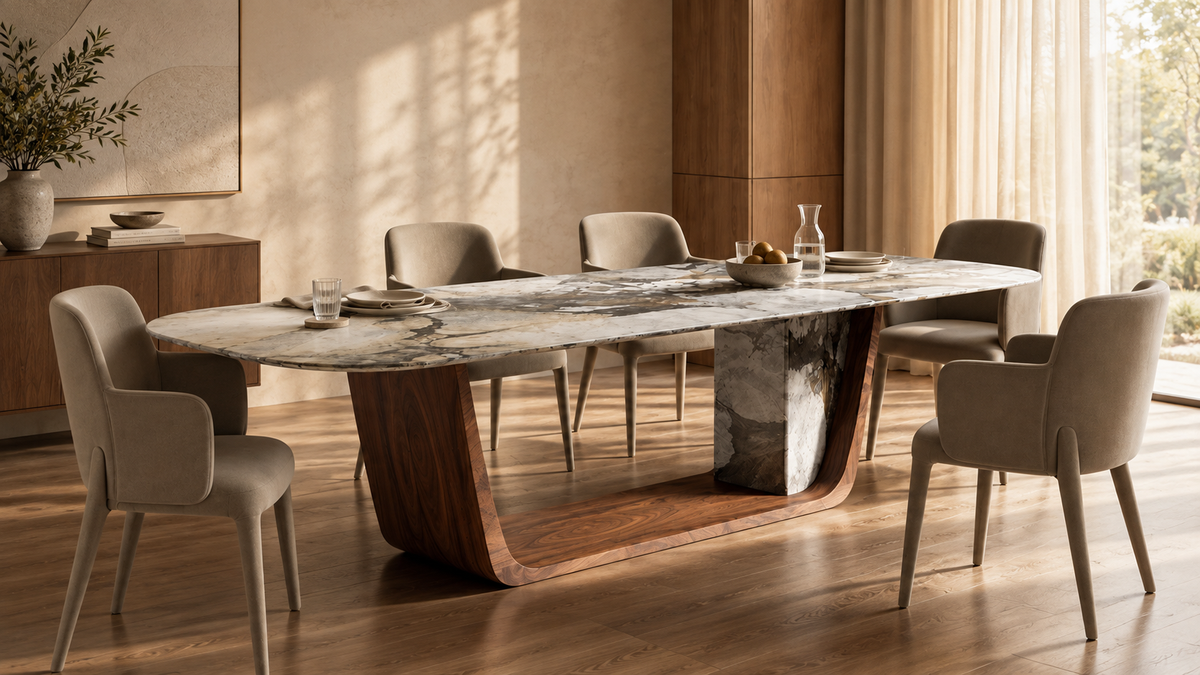
This becomes particularly relevant with sculptural furniture, where the base itself can form a significant part of the design.
Made to order and mass production
How furniture is produced can also affect its price.
Large-scale production can make it possible to manufacture identical or near-identical products in significant quantities and hold them in stock ready for dispatch.
Made-to-order furniture works differently. Production begins in response to an order rather than the customer simply receiving an item taken from finished stock.
Neither model is automatically better for every customer. They simply represent different ways of producing and selling furniture.
At The Marble & Wood Co., our furniture is made to order using natural marble and wood. This also means natural variation is part of what customers should expect from the finished furniture.
Read our Made to Order guide here.
Size, weight and delivery
This is one of the less obvious differences when comparing prices online.
Natural stone is heavy. A large dining table constructed using substantial sections of marble presents very different handling and transportation requirements from lightweight flat-packed furniture.
Large furniture may require more substantial packaging and specialist handling throughout its journey. The final dimensions and weight of a product therefore affect more than the amount of raw material used.
This is particularly relevant when comparing a large natural marble dining table with a visually similar table made using a lighter marble-effect surface.
How can you tell if a marble table is real?
You don’t need to become a stone expert. Start by reading the product description carefully.
Look for specific wording such as “natural marble” rather than assuming that “marble finish”, “marble effect”, “marble look” or simply a marble-patterned photograph means natural stone.
Check:
- Materials: Does the specification explicitly state natural marble?
- Construction: Is the whole top natural stone, a veneer, or another material?
- Dimensions and weight: Do these help explain how the furniture is constructed?
- Natural variation: Does the retailer explain that veining and markings will vary?
- Product information: Is there enough detail to understand what you’re buying?
If the description is unclear, ask the retailer directly.
One caution about popular DIY tests for marble: acids can react with calcite, a major constituent of true marble, but deliberately applying acidic liquids to finished furniture can damage the surface. It isn’t a sensible way to test an expensive table at home.
So why can one marble table cost £300 and another £3,000?
Because the word “marble” alone isn’t enough to make a meaningful comparison.
The less expensive table may still be perfectly suitable for what you want. But before comparing prices, establish whether you’re looking at natural marble, a small amount of natural stone, a veneer, engineered material or a marble-effect surface. Then consider the size, construction, other materials and how the furniture is produced and delivered.
A £300 table and a £3,000 table appearing beside one another in a Google search may look as though they’re competing versions of the same thing.
Quite often, a closer look at the specifications shows that they aren’t.

Leave a comment
This site is protected by hCaptcha and the hCaptcha Privacy Policy and Terms of Service apply.